Program Assessment Awards

2024-2025 Award Winners
Comprehensive Excellence: Business Honors

Pictured: Claire Raabe and Jeff Glenn
Congratulations to the Business Honors program at Mays Business School on receiving the Comprehensive Excellence in Assessment award!
OIEE is pleased to recognize this program for its exceptional work in the 2024-2025 assessment cycle. In reviewing the program’s documentation, several strengths stood out:
- Strategic alignment of capstone assessment with program goals. Structured, rubric-based evaluation of final projects ensures complex outcomes are assessed intentionally and consistently.
- Data-informed curricular refinement. Faculty examined rubric sub-criteria to identify targeted areas for improvement and implemented instructional adjustments, including additional scaffolding and structured feedback activities.
- Collaborative, faculty-driven review. Assessment is embedded in committee review of student work, collective interpretations of findings, and shared decision-making—demonstrating broad faculty ownership of student learning.
- Thoughtful interpretation of new assessment data. In the first cycle of a new rubric, faculty drew on their understanding of honors student learning patterns to interpret early results and strengthen creative confidence and innovative thinking.
OIEE applauds the Business Honors program for modeling intentional, high-quality assessment and advancing a culture of continuous improvement at Texas A&M University.
Comprehensive Excellence: UG Communication Programs
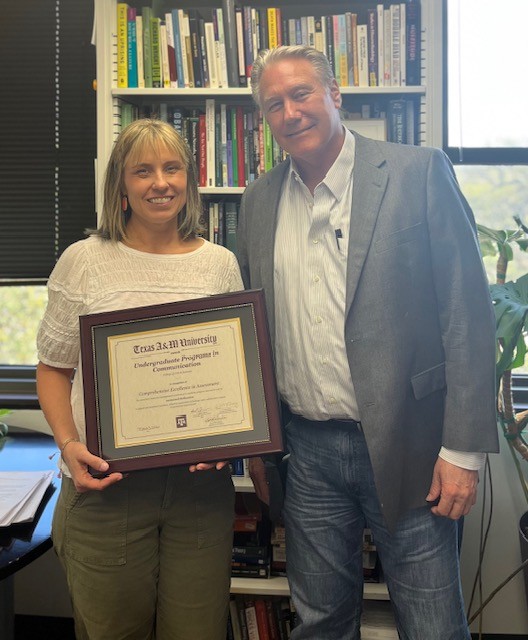
Pictured: Dr. Kristan Poirot and Dr. Larry Lemmons
Congratulations to the Communication Undergraduate Programs in the College of Arts and Sciences on receiving the Comprehensive Excellence in Assessment award!
OIEE is pleased to recognize this program for its exceptional work during the 2024-2025 assessment cycle. In reviewing the program’s documentation, several strengths stood out:
- Robust, systematic assessment design. Randomly selected student artifacts from all 400-level W courses are evaluated using a shared rubric and disaggregated by major, creating a thoughtful and sustainable approach to program-level evidence collection.
- Faculty development tied to findings. Assessment findings inform department-wide conversations and professional development on teaching practices, including how emerging tools such as generative AI are shaping writing instruction.
- Broad faculty ownership of improvement efforts. A structured two-year curriculum review process engages all program faculty, the Undergraduate Instruction Committee, department leadership, and formal faculty vote, demonstrating shared responsibility for program improvement.
OIEE applauds the Communication Undergraduate Programs for modeling high-quality, intentional assessment, and for its leadership in advancing continuous improvement at Texas A&M University.
Comprehensive Excellence: English PhD

Pictured: Dr. Joshua DiCaglio
Congratulations to the Doctor of Philosophy in English in the College of Arts and Sciences on receiving the Comprehensive Excellence in Assessment award!
OIEE is excited to recognize this program for its outstanding work in the 2024-2025 assessment cycle. In reviewing the program’s documentation, several strengths were noted:
- Strategic multi-point assessment. The program assesses student learning at preliminary exams, prospectus defense, and dissertation stages, allowing faculty to examine progression over time rather than relying on a single end point—reflecting a thoughtful, longitudinal approach to doctoral learning.
- Data-driven refinement of dissertation-stage support. When “exceeds expectations” scores declined at the dissertation stage, the program identified a targeted area for improvement and implemented aligned interventions.
- Substantive, well-resourced actions aligned with findings. The introduction of a funded research semester, expanded research support, and a publication initiative reflects a coordinated, faculty-led effort to strengthen methodological sophistication at the stage where assessment identified need.
OIEE applauds the Doctor of Philosophy in English for modeling high-quality, intentional assessment, and for its leadership in advancing continuous improvement at Texas A&M University.
Continuous Improvement: Business MS

Pictured: Dr. Mike Alexander and Lisa Provines
Congratulations to the Master of Science in Business at Mays Business School on receiving the Continuous Improvement Award!
OIEE is pleased to recognize this program for its outstanding approach to improvement in the 2024-2025 assessment cycle. In reviewing the program’s documentation, several strengths were noted:
- Strategic use of longitudinal benchmarking data: The program used four years of data to pinpoint specific conceptual gaps and target improvements with precision.
- Decisive, data-informed curricular change: The program removed a course from the degree plan and reallocated credits to strengthen Excel integration and add a Leadership course aligned with learning gaps.
- Integration of direct and indirect measures: Student course evaluation trends supported results from direct measures, strengthening focus on priority areas for improvement.
- Closing the loop with demonstrable impact: Prior changes led to measurable gains in subtest scores and CLA+ results, showing improved Program Learning Outcome achievement.
OIEE celebrates the Master of Science in Business for its creative, evidence-based approach to improvement and its dedication to enhancing learning through thoughtful assessment practice.
Continuous Improvement: Urban & Regional Planning BS

Pictured: Dr. Justin Golbabai and Dr. Galen Newman
Congratulations to the Bachelor of Science in Urban and Regional Planning in the College of Architecture on receiving the Continuous Improvement award!
OIEE is pleased to recognize this program for its outstanding approach to improvement in the 2024-2025 assessment cycle. In reviewing the program’s documentation, the following strengths were noted:
- Embedding assessment within accreditation preparation. The program commendably centered assessment in its pursuit of PAB accreditation by conducting a detailed review of its 50-credit core and identifying learning gaps. Proposed curricular changes—expanding, resequencing, and adding new courses—were explicitly tied to strengthening multiple program learning outcomes.
- Transparent reporting and realistic expectations for impact. The program provided a substantive update on implemented changes, noting that immediate gains in Program Learning Outcome achievement were not yet expected and clearly outlining when measurable improvements in student learning should emerge—reflecting an understanding of the iterative nature of assessment.
OIEE celebrates the Bachelor of Science in Urban and Regional Planning for its evidence-based approach to improvement and its dedication to enhancing learning through thoughtful assessment practice.
Initiative & Goals
The Program Assessment Awards initiative at Texas A&M University seeks to recognize and celebrate programs who demonstrate excellence in academic assessment practices. Through strategic recognition, the initiative fosters a culture of reflective, data-informed decision-making that drives continuous improvement in program learning outcomes. By elevating the visibility and value of assessment, the initiative encourages deeper engagement across academic units. The Assessment Awards aim to normalize and elevate assessment as a valued academic practice, encouraging consistency, transparency, and innovation through recognition and rewards to support continuous improvement at Texas A&M University.
The goals of this initiative are to:
- To recognize and celebrate programs that demonstrate excellence in assessment practices.
- To elevate the visibility and value of assessment, and to encourage deeper engagement in the process.
Program Award Details
The Office of Institutional Effectiveness and Evaluation has two awards: the Comprehensive Excellence in Assessment Award and the Continuous Improvement Award. Specific award descriptions and criteria are below.
Comprehensive Excellence in Assessment Award
This award recognizes programs that embody a spirit of excellence in assessment by engaging in intentional, reflective, and collaborative practices. Honorees demonstrate that assessment is not simply a reporting exercise but a meaningful process that informs decisions, fosters innovation, and continuously advances understanding of student learning.
Award decisions are based entirely on what is documented in the submitted reports. Programs are expected to convey their practices clearly through narrative and supporting evidence.
Award Criteria:
- Cohesion and Alignment: The assessment report tells a clear and consistent story, with outcomes, measures, findings, and actions aligned in a way that demonstrates intentional design and purpose.
- Curiosity and Robust Assessment Design: The program approaches assessment with curiosity and adaptability, embracing new strategies and approaches to strengthen assessment practice. This may include rotating outcomes, piloting new tools, revising rubrics, or adjusting data collection to gain deeper insight. Robust methods — including varied approaches and multi-dimensional measures — support a rich and reflective understanding of student learning.
- Reflective Use of Results: The program demonstrates a culture of assessment where findings are used to guide meaningful actions, reflection on past efforts is evident, and the commitment to continuous improvement is woven throughout the narrative.
- Collaboration and Shared Commitment: The assessment report reflects a shared responsibility, with members of the program contributing to interpreting evidence, identifying improvements, and implementing actions. The collaborative approach underscores a collective commitment to improvement rather than the work of a single individual.
Continuous Improvement Award
This award recognizes programs where faculty take collective ownership of assessment and work together to design intentional, creative actions that support student learning. Honorees demonstrate that meaningful improvement is grounded in shared commitment, thoughtful planning, and sustained follow-through. Creative or transformative efforts are those that reflect fresh thinking, adaptive responses to findings, or shifts in practice that lead to more effective teaching and learning. The emphasis is on purposeful change developed through collaborative reflection.
Award decisions are based entirely on what is documented in the submitted reports. Programs are expected to convey their practices clearly through narrative and supporting evidence.
Award Criteria:
- Faculty as Change Agents: Faculty engagement is evident in shaping the direction, purpose, and execution of data-informed action(s). The report reflects a culture of shared ownership and collaborative responsibility for student learning and improvement.
- Inventive or Transformative Approach: The proposed action reflects creative or experimental thinking and demonstrates a meaningful shift in practice—whether through instructional design, curriculum, or student engagement strategies. The scope and scale of the action reflect intentionality and support meaningful, lasting improvements in student learning. Even if modest in scope, the action is thoughtfully aligned with findings and designed for impact.
- Coherence and Readiness of Action: The action is rooted in clear intention, with thoughtful planning that connects rationale to implementation. Steps, roles, and timing are articulated in a way that demonstrates careful planning for coordinated execution.
- Reflective Momentum and Outcome Reengagement: The program demonstrates thoughtful follow-through by sharing updates, insights, or adaptations stemming from previous actions. Reflection is used to evaluate progress and revisit the original learning outcome, showing that the improvement process is ongoing and evidence-informed.
Liaison Award Details
The Office of Institutional Effectiveness and Evaluation has one award for Liaisons: the Assessment Liaison Impact Award. Specific award description and nomination information is below.
Assessment Liaison Impact Award
The Assessment Liaison Impact Award is a peer-nominated award recognizing Assessment Liaisons who exemplify outstanding partnership in advancing the quality of academic program assessment within their college, school, or campus. Through sustained engagement, assessment expertise, collaborative relationships, continuous improvement, and faculty empowerment, recipients strengthen assessment practices and foster a culture of meaningful, data-informed improvement.
Nomination Process:
Program Coordinators are invited to submit a brief narrative describing why their Assessment Liaison deserves recognition, including specific examples of the liaison’s contributions and impact during the previous academic year.
Contributions may take many forms, including providing responsive or knowledgeable guidance, building strong working relationships, helping programs navigate assessment challenges, strengthening assessment practices, developing useful resources or approaches, or helping faculty and program coordinators build confidence and capacity. These examples are intended to guide the nomination rather than serve as requirements; nominators should focus on the contributions they found most meaningful or valuable.
500-word max, optional supporting documentation.
Deadline for Nominations: October 31
Eligibility
Any individual who served as an Assessment Liaison during the previous academic year is eligible for nomination, including those who are no longer serving in the role. Program Coordinators may nominate the Assessment Liaison assigned to support their program during that year in recognition of the liaison's contributions and impact on the program's assessment practices.
Review Process
Nominations will be independently reviewed by multiple reviewers from the Office of Academic Planning and Institutional Effectiveness (APIE), with consideration given to the quality and specificity of the information provided and the impact demonstrated through the nomination.
Award Presentation
Awardees and nominators will be notified in mid-November.
Award Winner Recognition
Winners will receive:
- A framed award certificate made out to the program/liaison
- Letters of Recognition sent to Department Head and college Dean
- An OIEE website spotlight